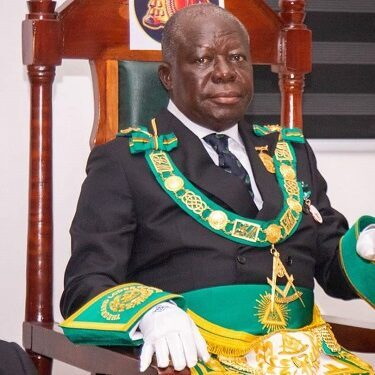
Freemasonry arrived in Ghana during the colonial era, with the first lodge established in Accra around 1810, initially serving British expatriates. Over time, it grew to include local members and was eventually organized under local Grand Lodges, culminating in the formation of the Grand Lodge of Ghana in 2009. The organization now operates as a fraternal body with a history of social, charitable, and moral activities in the country.
Early history (19th century)
- Colonial introduction: Freemasonry was brought to the Gold Coast (modern-day Ghana) by the British during the colonial era.
- First lodge: The first Masonic lodge was founded in Accra on April 11, 1810, and was under the jurisdiction of the United Grand Lodge of England.
- Expatriate focus: Early lodges were primarily composed of British colonial officials, traders, and military personnel who used them as social and networking clubs.
Growth and development (20th century to present)
- Expansion: Lodges continued to operate under the authority of the English, Irish, and Scottish Grand Lodges, eventually forming administrative Districts and a Province within Ghana.
- Local participation: As the country developed, the membership expanded to include a broader base of local citizens.
- Grand Lodge of Ghana: A significant development was the establishment of the Grand Lodge of Ghana on January 24, 2009, after a joint proposal from the sponsoring Grand Lodges.
- Current activities: The organization remains active, participating in various charitable endeavors throughout the country, such as providing water systems to communities, and focuses on the values of integrity, charity, and moral improvement.
LOREM IPSUM DOLOR
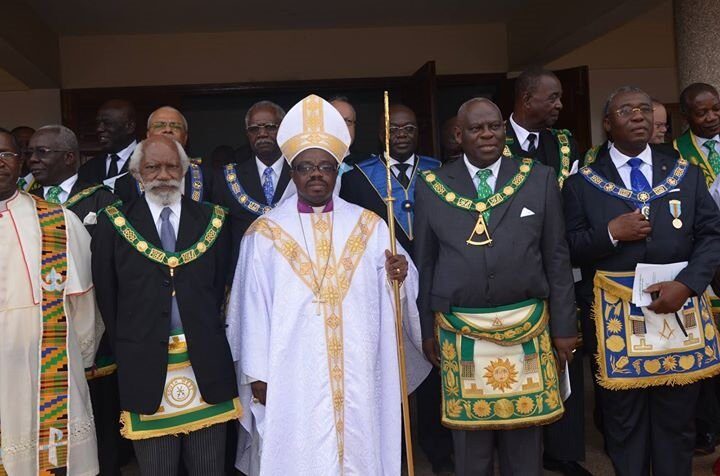
Asantehene Otumfuo Osei Tutu II
He made this statement during a grand ceremony marking his 25-year tenure on the Golden Stool and in Freemasonry.
"This may be a great opportunity to discuss forming a grand lodge for females attached to the grand lodge of Ghana," he said referencing the successful presence of female lodges within the grand lodge structures of Liberia, akin to those in England.
Read more: Grand Ceremony held to celebrate Asantehene’s 25 years in Freemasonry
The origins of women's Freemasonry can be traced back to 18th-century pre-revolutionary France, where Lodges of Adoption welcomed women alongside men. However, these lodges diminished during the revolutionary periods.
In 1882, Maria Deraismes, a French social reformer, was invited to join a men's Lodge, leading to the emergence of mixed lodges.
This concept later spread to the United Kingdom in 1902 through Annie Besant, eventually evolving into the Order of Women Freemasons in 1908.
Read more: ‘No regrets’ – Asantehene reflects on 25 years in Freemasonry
By 1913, a subset within the Order decided to practice the Royal Arch degree, leading to the formation of the HFAF, exclusively for women Freemasons.
L
This transition from co-masonry to exclusive female membership was accomplished by the mid-1930s, marking a significant development in women's Freemasonry history.orem ipsum dolor sit amet, at mei dolore tritani repudiandae. In his nemore temporibus consequuntur, vim ad prima vivendum consetetur. Viderer feugiat at pro, mea aperiam.